
Ashwagandha and Shilajit for Stamina: Do They Actually Work?
Published October 24, 2026
Medically reviewed by Chep Meds USA Pharmacy Team
Content checked by our licensed pharmacists for accuracy against standard prescribing information. Last reviewed October 2026. Our editorial policy
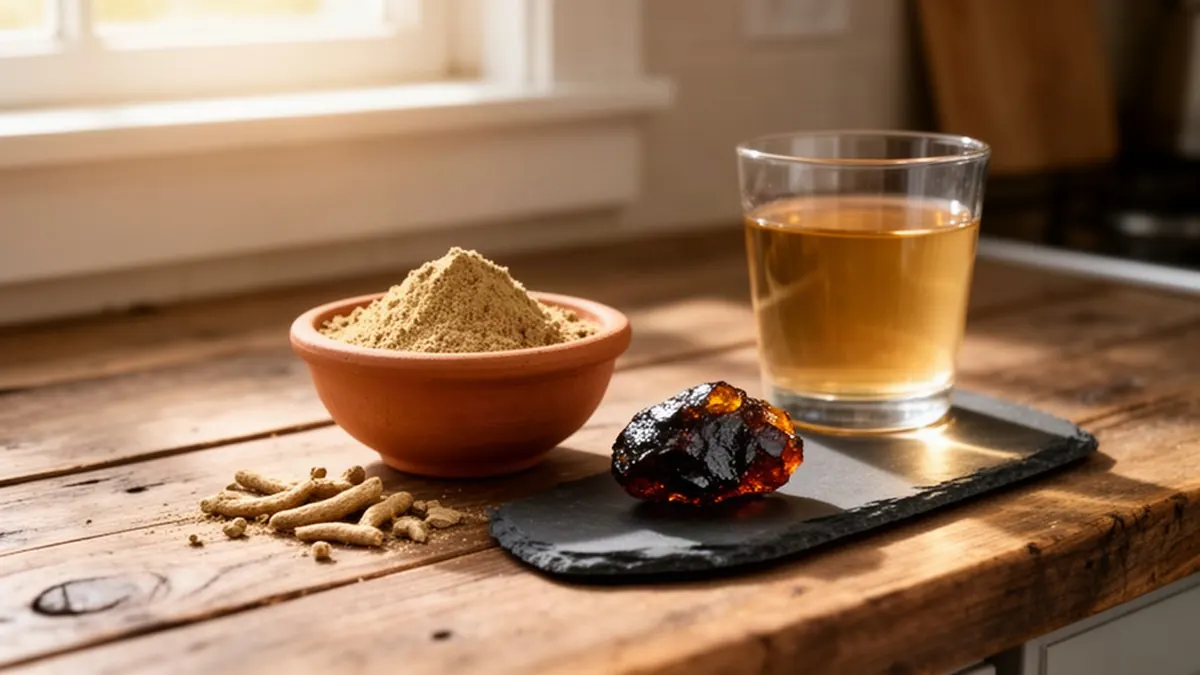
You're getting seven hours of sleep, eating reasonably well, and you still feel like you're running on a half-charged battery by two in the afternoon. Sound familiar? Maybe a friend swears by ashwagandha, or you saw shilajit resin on a health influencer's shelf and thought, 'Is that tar? Am I supposed to eat that?' These two herbs—well, one herb and one mineral pitch—have been used in Ayurvedic medicine for literally thousands of years, and recently they've landed hard in mainstream American wellness culture. Before you drop money on either of them, let's talk about what they are, what the human evidence actually looks like, and where they fit realistically into your life.
What Even Is Shilajit? (No, It's Not Tar)
Shilajit is a sticky, blackish-brown resinous substance that oozes out of rocks in high-altitude mountain ranges—the Himalayas, the Altai, parts of Central Asia. Over centuries, decomposed plant matter compresses and transforms under geological pressure into something that's rich in fulvic acid, humic acid, and a range of trace minerals. It looks weird. It smells like ancient earth. And yes, people eat it.
In Ayurvedic tradition it's called a 'rasayana'—a rejuvenating substance meant to strengthen the body over time. Fulvic acid is the compound that most researchers focus on because it may help transport nutrients into cells and has antioxidant properties. The mineral content—things like iron, zinc, magnesium—could also play a real role if you happen to be running low on any of those. That's worth keeping in mind: sometimes 'fatigue' is just a magnesium deficiency in disguise.
Quality varies enormously with shilajit. Raw or unprocessed forms can contain heavy metals, so you genuinely want a purified product that's been tested by a third party. If a brand can't tell you where their shilajit was tested, skip it. This isn't paranoia—it's just common sense with any supplement that comes straight out of a mountain.
Ashwagandha: The Adaptogen with Actual Data Behind It
Ashwagandha (Withania somnifera) is a shrubby plant native to India and North Africa. Its root is the part used medicinally, and it belongs to a category called adaptogens—plants thought to help the body cope with physical and mental stress. The active compounds are withanolides, and they've been studied more thoroughly than most herbal ingredients. That's what makes ashwagandha stand out from the crowded supplement aisle.
A well-cited 2012 study published in the Indian Journal of Psychological Medicine gave 300 mg of ashwagandha root extract twice daily to stressed adults for 60 days. The group taking it showed significantly lower cortisol levels and reported less stress and better overall well-being compared to placebo. Cortisol is your main stress hormone, and chronically elevated cortisol wrecks your energy, your sleep, and your mood. Bringing it down matters. A 2015 study in the Journal of the International Society of Sports Nutrition also found improvements in muscle strength and recovery in resistance-trained men taking ashwagandha versus placebo.
Does this mean ashwagandha will turn you into a different person? No. But if chronic stress is part of why you feel depleted—and for a lot of Americans it is—there's a reasonable scientific case that ashwagandha might help take the edge off that physiological stress response. It's not a stimulant. You won't feel it like a cup of coffee. It works slowly, over weeks.
- Typical studied dose: 300–600 mg of root extract daily
- Takes 4–8 weeks to notice effects in most studies
- KSM-66 and Sensoril are well-researched branded extract forms
- Generally well tolerated; mild GI upset reported in some people
- Avoid if pregnant—it may stimulate uterine contractions
The Stamina Question: What Does Research Say for Each?
Let's get specific. 'Stamina' covers a lot of ground—cardio endurance, strength, mental focus, libido, recovery time. The evidence for ashwagandha is strongest in the stress-and-recovery category. A 2021 study in the journal Nutrients looked at recreational athletes and found those taking ashwagandha had better VO2 max scores and faster recovery after exercise. VO2 max is how efficiently your body uses oxygen during sustained effort—it's a real marker of cardiovascular fitness. That's a meaningful finding, not a trivial one.
For shilajit, a small but interesting 2016 study in the Journal of the International Society of Sports Nutrition gave 200 mg of purified shilajit twice daily to healthy men for 8 weeks. They maintained muscle strength better and showed less muscle damage markers compared to placebo after exercise. A 2019 study also linked shilajit supplementation to higher testosterone levels in men with low-normal testosterone—not men with clinically diagnosed deficiency, but men in that frustrating gray zone. The sample sizes were small. These aren't slam-dunk results. But they're not nothing either.
The honest answer: both substances show legitimate promise in human trials, but we're not talking about hundreds of large randomized controlled trials here. We're talking about smaller studies with real but modest effect sizes. If you expect to feel like a different person in a week, you'll be disappointed. If you're willing to give it 6–8 weeks and track how you actually feel, you might be pleasantly surprised.
Combining Them: Does the Stack Make Sense?
You'll see ashwagandha and shilajit sold together in a lot of products right now, marketed as a power duo. There's some logic to it. Ashwagandha works more on the hormonal-stress axis—blunting cortisol, supporting thyroid function, calming the nervous system. Shilajit works more at the cellular level—mitochondrial energy, mineral delivery, testosterone support. Different mechanisms potentially complementing each other.
There isn't a robust clinical trial specifically studying the combination yet. That's just the reality. But neither is there any known interaction between them that would make combining them unsafe for a healthy adult. If you're on thyroid medication, talk to your doctor first—ashwagandha can affect thyroid hormone levels, and that's a real clinical consideration, not me being overly cautious.
If you do try them together, keep it simple. Start with one for four weeks, note any changes, then add the other. That way you actually know what's doing what. Taking six new supplements at once and feeling better tells you nothing useful.
- No known dangerous interaction between the two
- Try one at a time if you want to track effects properly
- Tell your doctor if you're on thyroid meds, blood pressure drugs, or immunosuppressants
- Morning is a common time to take both—neither causes drowsiness at standard doses
- Shilajit resin dissolved in warm water is a traditional method; capsules work too
Who Might Actually Benefit—and Who Probably Won't
Here's where I want to be honest with you. If your fatigue is coming from untreated sleep apnea, iron deficiency anemia, hypothyroidism, or depression, no herb is going to fix that. Get bloodwork done. A basic panel—CBC, thyroid, ferritin, vitamin D, B12—can rule out the stuff that actually needs treatment. I've talked to too many people who spent months on supplements when a simple ferritin check would have shown them they needed iron, full stop.
Where these supplements make the most sense: you're a reasonably healthy adult who sleeps decently, eats okay, exercises some, but just feels like your recovery is slow, your stress is high, or your energy ceiling is lower than it used to be. Middle-aged men with low-normal testosterone might find shilajit particularly relevant. People with demanding, high-stress jobs or training loads might find ashwagandha genuinely useful. These aren't edge cases—that describes a lot of people.
Athletes looking for a legal, non-stimulant edge in recovery and endurance? Ashwagandha especially is worth considering. It's not a banned substance in any sports federation I'm aware of. And unlike caffeine, you're not going to feel jittery or crash afterward.
Buying Smart: What to Look for on the Label
The supplement market in the US is loosely regulated. The FDA doesn't approve supplements before they hit shelves. That puts the burden on you to shop carefully. For ashwagandha, look for standardized extracts—KSM-66 or Sensoril are the forms used in most clinical trials, and they've been tested for purity. A product that just says 'ashwagandha root powder' with no standardization isn't necessarily bad, but it's less predictable in terms of active compound content.
For shilajit, third-party testing is non-negotiable. Look for NSF, USP, or Informed Sport certification on the label, or a certificate of analysis (COA) from an independent lab available on the brand's website. Check for heavy metal screening specifically. Himalayan or Central Asian sourcing is generally preferred. Avoid anything suspiciously cheap—quality purification costs money.
Dose matters too. Don't go above studied doses thinking more is better. 300–600 mg of ashwagandha extract and 250–500 mg of purified shilajit per day cover the ranges used in most positive trials. More than that doesn't mean more benefit—it means more potential for side effects and a lighter wallet.
- Look for KSM-66 or Sensoril on ashwagandha labels
- Shilajit should have third-party heavy metal testing documented
- NSF, USP, or Informed Sport certification adds credibility
- Avoid megadoses—more isn't better here
- Check that the brand publishes a COA on request
Medicines mentioned in this article
- Myherb Ashwagandha Powderfrom $34.99
- Boldveda Ashwagandha Tablets for Men & Womenfrom $32.99
- Carmel Organics Ashwagandha Extract Tabletsfrom $34.99
- Penon Cream (Penis Enlargement Cream)from $21.99
- Baby Lotion 40 mLfrom $2.99
- Dabur Shilajit Capsulefrom $11.99
Common questions
How long before I feel a difference with ashwagandha?
Most studies showing meaningful results run 8 weeks minimum. Some people notice less anxiety or better sleep around the 4-week mark, but don't write it off before 6–8 weeks. If nothing at all has changed by then, it may just not be the right tool for what's driving your fatigue.
Can women take shilajit?
Yes, most of the safety concerns around shilajit apply equally to men and women, and the main issue is product purity rather than gender. The testosterone-related studies focused on men, but shilajit's mitochondrial and antioxidant effects aren't sex-specific. As always, skip it during pregnancy or breastfeeding, and check with your OB if you have hormone-sensitive conditions.
Will these supplements show up on a drug test?
Ashwagandha and shilajit are not controlled substances and are not on standard drug screening panels used by employers or sports organizations. That said, poor-quality supplements can be contaminated with unlisted ingredients, which is one more reason to buy from brands that do third-party testing.
Can I take ashwagandha every day long-term?
Human studies have run as long as 12 weeks with a good safety profile. Long-term daily use beyond that hasn't been extensively studied, so some practitioners suggest cycling—say, 8 weeks on, a few weeks off. There's no hard evidence that continuous use is harmful, but cycling is a reasonable precaution until we have more data.