
Yoga Poses That Can Help Improve Erectile Dysfunction
Published October 24, 2026
Medically reviewed by Chep Meds USA Pharmacy Team
Content checked by our licensed pharmacists for accuracy against standard prescribing information. Last reviewed October 2026. Our editorial policy
You're not sleeping great, work has been relentless, and somewhere along the way your sex life quietly took a hit. Sound familiar? A lot of men in that situation head straight to their doctor asking about medication — which is sometimes exactly the right move — but plenty of them are surprised when their doctor also mentions lifestyle changes, including exercise. Yoga probably isn't the first thing that comes to mind when you think about erectile dysfunction. It sounds too gentle, too slow, maybe a little too far from a locker room. But here's the thing: ED is fundamentally a circulation and nervous-system problem, and yoga works directly on both. It lowers cortisol, improves blood vessel flexibility, strengthens the pelvic floor, and trains the kind of body awareness that matters in the bedroom. None of this replaces a conversation with your doctor, especially if ED came on suddenly or you have cardiovascular risk factors. But as a complement to whatever treatment plan you're already on, a 20-minute yoga practice three or four days a week is genuinely worth your time.
Why Yoga and ED Are More Connected Than You Think
Erections depend on relaxed smooth muscle, healthy blood vessels, and a nervous system that isn't stuck in fight-or-flight mode. Chronic stress floods your body with cortisol and adrenaline, both of which cause blood vessels to constrict. That's the opposite of what needs to happen for an erection. Yoga — specifically slow, breath-focused yoga — activates the parasympathetic nervous system, the one responsible for rest, digestion, and yes, sexual arousal.
A 2010 study published in the Journal of Sexual Medicine followed 65 men through a 12-week yoga program. By the end, participants reported meaningful improvements in desire, erection quality, and overall sexual satisfaction. No medication involved. That's not magic. That's physiology responding to consistent, targeted movement and breathwork.
There's also the pelvic floor angle. Most men don't think about their pelvic floor muscles at all, but these muscles — the same ones you'd clench to stop urination midstream — play a direct role in maintaining erections and controlling ejaculation. Yoga poses that engage the hips, inner thighs, and lower abdomen gently strengthen that whole region.
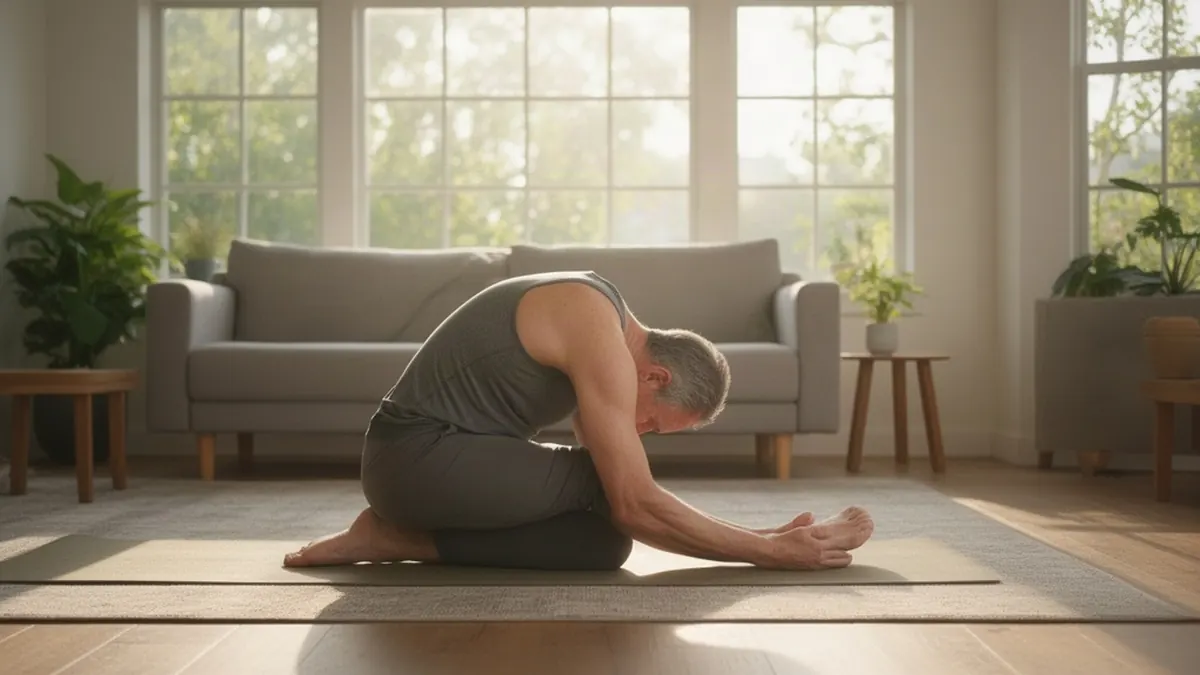
Paschimottanasana (Seated Forward Bend)
Sit on the floor with your legs straight out in front of you. Inhale to lengthen your spine, then exhale and fold forward, reaching toward your feet. Don't force it — if you can only reach your shins, that's completely fine. Hold for 30 to 60 seconds and breathe steadily.
This pose stretches the perineal muscles and the entire posterior chain, from your hamstrings up to your lower back. Tension in those areas restricts blood flow to the pelvic region. Releasing it — slowly, over multiple sessions — lets circulation improve. It also has a calming effect on the nervous system, which is half the battle with stress-related ED.
Try this one first thing in the morning or right before bed. Five minutes of seated forward bending can shift your nervous system out of high-alert mode faster than most people expect.
Uttanasana (Standing Forward Bend)
Stand with your feet hip-width apart. Hinge at the hips — not the waist — and let your torso hang toward the floor. Bend your knees generously if your hamstrings are tight. Let your head hang heavy. Hold for 45 seconds to a minute.
This is an inversion, meaning your hips are above your heart. Inversions encourage blood to flow back toward the trunk and pelvis. After you stand back up, there's a surge of fresh, oxygenated blood into the lower body. Do this a few times in a row and you've essentially given your pelvic vasculature a mild workout.
Uttanasana also decompresses the lumbar spine. Lower back tension is surprisingly common in men with ED, partly because they spend all day sitting, and tight back muscles can impinge the nerves that control pelvic function. Loosening that area matters more than most guys realize.
Baddha Konasana (Butterfly Pose)
Sit on the floor, bring the soles of your feet together, and let your knees fall out to the sides. Hold your feet or ankles and sit tall. You can stay upright or fold gently forward. Hold for one to two minutes.
This is the pose most directly tied to the pelvic floor and inner groin. It opens the hip adductors and stretches the perineum — the tissue between the scrotum and anus where a lot of pelvic floor tension lives. Men who sit at a desk all day often have chronically tight adductors without knowing it, and that tightness compresses blood flow to the genitals.
Be patient with this one. The first few times you try it, your knees might hover several inches off the floor. That's normal. Over a few weeks, you'll notice the tension release. Regular practice of butterfly pose has been specifically mentioned in several small studies on yoga and male sexual function as one of the most effective positions for improving pelvic circulation.
- Keep your spine long, not rounded
- Place folded blankets under your knees if they don't reach the floor
- Breathe deeply into your belly, not your chest
- Aim for 3 to 5 sessions per week for noticeable change
Dhanurasana (Bow Pose)
Lie on your stomach. Bend your knees, reach back, and grab your ankles. Inhale and lift your chest and thighs off the floor simultaneously, so your body forms a bow shape. Hold for 20 to 30 seconds, breathing steadily.
Bow pose does several things at once. It stretches the hip flexors and the front of the thighs, both of which get shortened and tight from prolonged sitting. It also compresses and then releases the abdominal organs, stimulating circulation in that region. And it requires real core and back engagement, which builds the kind of functional strength that supports pelvic floor function.
Skip this one if you have a lower back injury or recent abdominal surgery — check with your doctor first. But for most healthy men, it's one of the more powerful poses in this list. It's challenging enough to feel like actual exercise, which for guys skeptical about yoga being 'real' movement, can be a helpful entry point.
Savasana and Breathwork: The Part Most Men Skip
Here's what kills most guys' yoga practice before it gets a chance to work: they skip the last five minutes of rest. Savasana — lying flat on your back, completely still — isn't filler. It's when your nervous system consolidates everything you just did. Skipping it is like stopping a download at 95 percent.
Pair it with slow diaphragmatic breathing: inhale for four counts, hold for one, exhale for six. That extended exhale activates the vagus nerve and shifts you hard into parasympathetic mode. Do this for five minutes at the end of your session. Then, a few times throughout your day — even sitting in your car before you go into work. Breath is the fastest tool you have to change your nervous-system state, and nervous-system state is deeply tied to erectile function.
Performance anxiety is one of the most underappreciated drivers of ED in younger men especially. Regular breathwork builds real-time regulation skills — meaning when anxiety starts to spike in a sexual situation, you actually have a tool to work with, not just a hope that it resolves on its own.
How to Build This Into Your Week Without Overthinking It
You don't need a $40 studio class or a fancy mat. Unroll something cushioned on your bedroom floor, pull up a free video for guidance if you want it, and aim for 20 minutes three or four days a week. That's genuinely enough to start seeing changes in six to eight weeks.
The sequence that makes sense: butterfly pose to warm up the hips (2 minutes), standing forward bend (1 minute), seated forward bend (2 minutes), bow pose if appropriate (3 sets of 20 seconds), then finish with 5 minutes of savasana and breathwork. Total time: about 18 minutes. You can do this before your morning shower.
And please — if your ED is persistent, came on suddenly, or is accompanied by other symptoms like chest tightness or fatigue, see your doctor. ED can be an early sign of cardiovascular disease, and yoga, while genuinely helpful, is not a substitute for a proper workup. Think of it as a powerful addition to whatever your doctor recommends, not a replacement.
- Start with 3 days per week and build from there
- Morning practice works well — your pelvic muscles are often tightest after sleep
- Track your sleep and stress levels alongside your practice; they're connected
- Give it at least 6 weeks before judging results
Common questions
How quickly can yoga improve erectile dysfunction?
Most men who stick with a consistent practice — three or more sessions per week — start noticing changes in six to twelve weeks. It's not a quick fix, but the improvements tend to compound over time as pelvic circulation, muscle tone, and stress levels all shift together.
Is yoga enough on its own to treat ED?
Honestly, it depends on the cause. If your ED is primarily stress-related and your cardiovascular health is otherwise solid, yoga alone can make a real difference. If there's an underlying condition like diabetes, hypertension, or low testosterone, yoga is supportive but you'll need medical treatment alongside it — talk to your doctor.
Do I need any yoga experience to try these poses?
No prior experience needed. All five poses described here are beginner-accessible with minor modifications. If you have knee, hip, or lower back issues, clear new exercises with your doctor first and use props like folded blankets or a bolster to reduce strain.
Can younger men benefit from yoga for ED too?
Absolutely. Performance anxiety and chronic stress are the dominant drivers of ED in men under 40, and yoga addresses both more directly than most other interventions. Breathwork in particular builds the nervous-system regulation skills that help in exactly the moments anxiety tends to spike.